

Architectural Value: Why Architects Are Underpaid and How to Fix It
You spent years in studio, pulling all-nighters to master the art of space, yet you are likely underpaid relative to the immense liability you carry. Why does this disparity exist? The answer lies in how the industry defines success. Currently, we sell aesthetics, but our clients buy results. Consequently, we must fundamentally redefine architectural value. It is not merely about how a building looks; rather, it is about how it performs as a financial and human asset.
If you cannot prove your design works, you are just another designer competing on price. But when you anchor your architectural value in hard data, you stop begging for fees and start commanding a share of the profit. Here are the 9 secrets to doubling your income by mastering the science of performance.
TL;DR The Executive Summary +
In breve: this post explains the key ideas in a few practical points you can apply immediately.
- The Problem: Architects sell subjective "art," while clients want objective ROI.
- The Solution: Shift to Evidence-Based Design. Use data to prove architectural value.
- The Method: Focus on Psychology, Wellbeing, and Environmental metrics.
- The Result: Higher fees, defensible designs, and measurable client success.
Why Architectural Value is a Financial Metric
The disconnect in our industry exists because we treat architectural value as an artistic achievement rather than a financial performance metric. We assume clients will pay for genius. In reality, most clients are business owners, developers, or administrators who answer to a bottom line. Therefore, they view design fees as a sunken cost rather than an investment.
To double your money, you must change this narrative. You must demonstrate that architectural value is a revenue generator. When a design reduces sick days, increases retail dwell time, or speeds up patient recovery, it pays for itself. Thus, the architect becomes a strategic partner, not just a vendor.
The 9 Secrets: A Framework for Evidence-Based Revenue
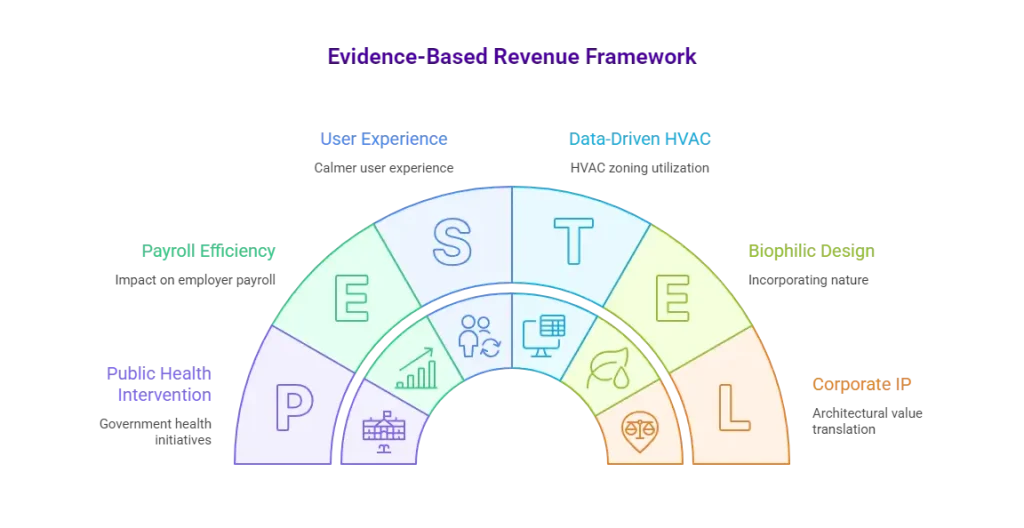
To increase your fees, you must operationalize the psychology of space and the physiology of wellbeing. Here is the framework to prove your worth.
1. Monetize Cognitive Load
Poor acoustics and visual clutter destroy focus. By designing to reduce cognitive load, you directly impact an employer’s payroll efficiency. Sell the silence, not the insulation.
2. The Biophilic ROI
Incorporating nature is not decorative; it is biological. Studies show biophilic design reduces stress markers. Consequently, you are selling health insurance, not just plants.
3. Circadian Alignment
Lighting dictates hormonal balance. Evidence-based lighting design improves sleep and mood. Therefore, you are providing a public health intervention.
4. Spatial Syntax and Collaboration
Do not just draw corridors; analyze traffic flow. Prove that your layout increases “collision density” and sparks innovation. This is architectural value translated into corporate IP.
5. Thermal Comfort and Productivity
Temperature complaints are the number one office grievance. By utilizing data-driven HVAC zoning, you eliminate distractions.
6. Wayfinding as Stress Reduction
In healthcare and transit, getting lost causes anxiety. Intuitive design reduces cortisol levels. You are selling a calmer user experience.
7. The Air Quality Multiplier
CO2 levels impact cognitive function. Designing for superior ventilation is an investment in clearer thinking for every occupant.
8. Retail Dwell Time
In commercial projects, comfort equals revenue. Evidence shows that ergonomic flow keeps customers in stores longer.
9. Post-Occupancy Evaluation (POE)
This is the ultimate secret. Return to the building, measure the results, and use that data to sell the next project.
Proving Architectural Value: Performance Metrics & Data
To command higher fees, you must speak the language of the CFO. Use these metrics to visualize the return on investment for your clients.
- Healthcare: Evidence suggests that access to nature can reduce hospital stays by 8.5%, significantly lowering operational costs.
- Workplace: Improved indoor air quality can boost productivity by up to 11%. For a company with high payroll, this dwarfs the design fee.
- Education: Students in classrooms with optimized daylighting progress 20% to 26% faster in math and reading tests.
- Retail: Simple changes in lighting temperature can increase sales conversion rates by 12%.
Action Steps to Double Your Fees
You cannot wait for the industry to change. You must act now.
- Audit Your Portfolio: Stop showing pretty pictures. Instead, write case studies that highlight the problem you solved and the measurable outcome.
- Change Your Contract: Include a clause for Post-Occupancy Evaluation. Make data gathering part of your standard service.
- Learn the Vocabulary: Read what your clients read. If you design hospitals, read medical journals. If you design offices, read the Harvard Business Review.
- Pitch the Outcome: Never pitch a “building.” Pitch increased productivity, faster healing, or higher sales.
Questions you might have
Overcoming Skepticism
Q1Doesn't relying on data kill creativity?Absolutely not.+
Data provides the constraints that fuel creativity. It ensures your "wild idea" actually functions for the human user.
Q2How do I prove ROI before the building is built?Use predictive modeling and reference existing peer-reviewed studies.+
This is the essence of architectural value—using past evidence to predict future success.
Q3Will clients really pay more for this?Yes. Clients always pay for certainty.+
"I think this looks good" is risky. "Data shows this layout increases revenue" is a safe investment.
The Future of Architectural Value: From Intuition to Evidence
The era of the “opinionated genius” is fading. In its place, the industry is demanding the “knowledgeable expert”; a strategist who treats buildings as high-performance machines for human wellbeing. We now have the tools to tune these environments for specific, measurable outcomes.
This shift toward data-backed design is the foundation of architectural value. By applying the principles found in Evidence-Based Design Architecture, you remove the guesswork and transform a static structure into a high-performance asset. When you anchor your work in these proven frameworks, you do more than just increase your fees; you provide the undeniable results that allow you to double your income while building a better world.
Ready to Charge What You’re Worth?