
Biophilic Design ROI Productivity: One Better Way to Secure Profit
Your building is likely bleeding money, and it has nothing to do with utility costs. While developers often obsess over façade aesthetics or initial construction costs, they frequently ignore the single biggest financial lever in commercial real estate: biophilic design ROI productivity.
In a market saturated with “Class A” office space, tenants are no longer buying square footage; they are buying human performance. If your building feels sterile, it is functionally obsolete. However, if you treat the built environment as a machine for cognitive enhancement, you unlock premium valuation. Therefore, we must move beyond the opinion that “greenery looks nice” and embrace the data proving nature increases the bottom line.
TL;DR Quick summary of this post +
In breve: this post explains the key ideas in a few practical points you can apply immediately.
- The Problem: Modern offices are often stress-inducing environments that kill output.
- The Solution: Evidence-Based Architecture using biophilic principles.
- The Data: Biophilia can increase productivity by 6-15% and cognitive function by 26%.
- The Takeaway: Stop treating nature as decoration. Treat it as a capital asset that drives biophilic design ROI productivit.
Why Biophilic Design ROI Productivity Matters Now
The architectural industry is facing a crisis of relevance. For too long, design has been driven by the “Starchitet’s” ego rather than the user’s biological needs. Consequently, we have built glass boxes that look sleek in portfolios but perform poorly for human occupants.
The economic argument for change is undeniable. Consider the 3-30-300 rule of commercial real estate breakdown (per square foot, per year):
- $3 for utilities.
- $30 for rent.
- $300 for employee payroll.
Most developers focus entirely on the $30 (rent) or the $3 (energy efficiency). However, the massive opportunity lies in the $300. If an architect can demonstrate that a specific design intervention improves tenant output by even 2%, the financial gain dwarfs the cost of rent. This is where biophilic design ROI productivity becomes the most valuable metric in your pro forma.
The Framework: An Evidence-Based Approach
To secure profit, we must replace intuition with rigor. We do not guess; we measure. Our approach utilizes a tripartite framework to maximize biophilic design ROI productivity.
1. Evolutionary Psychology
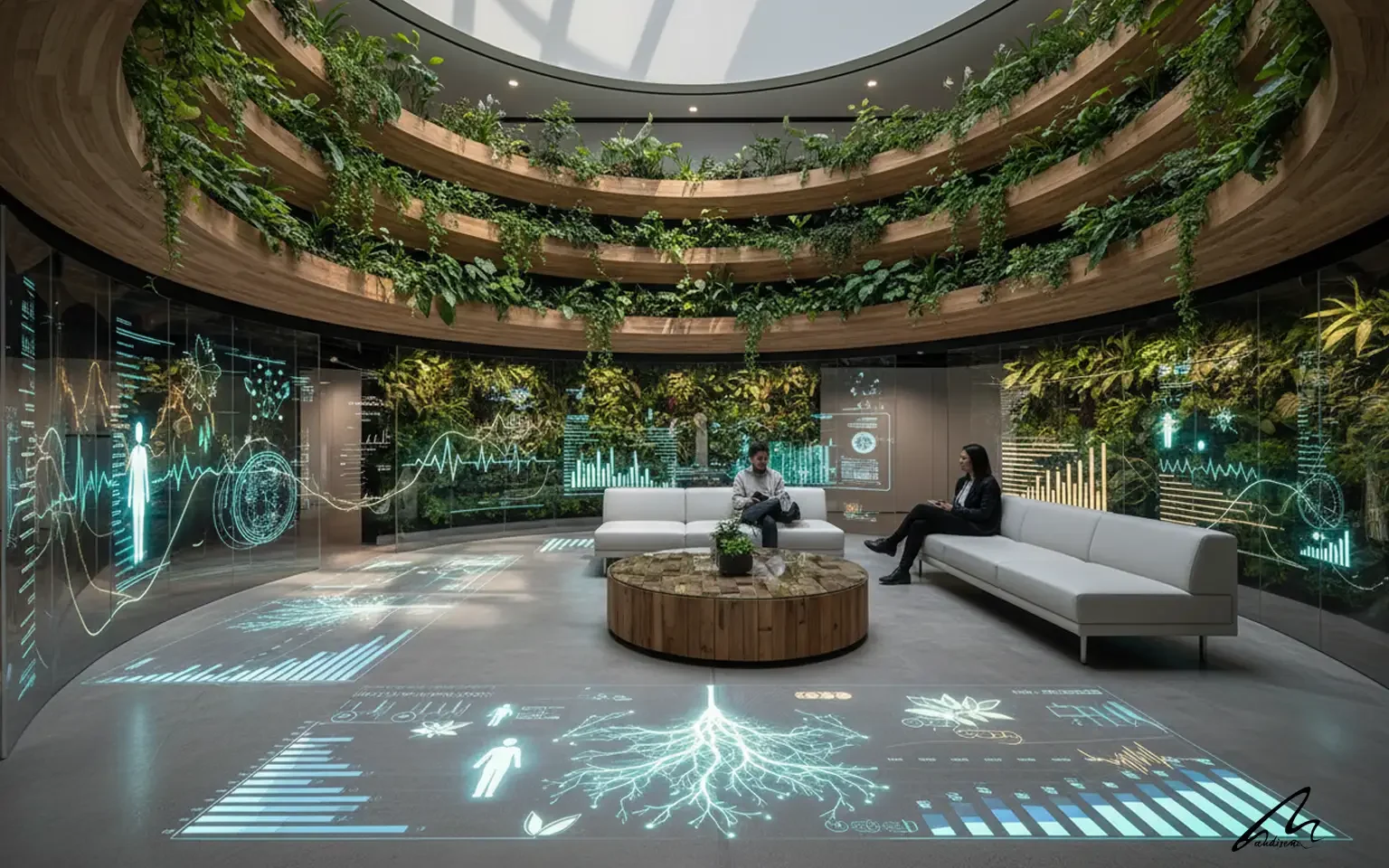
Humans are not wired for sterile drywall boxes. We possess an innate biological connection to nature (biophilia). When this connection is severed, cortisol levels spike. Conversely, reintroducing natural elements lowers heart rates and improves focus. This is not spiritualism; it is biology.
2. Cognitive Wellbeing
Air quality and visual complexity matter. High CO2 levels literally make us stupider. Furthermore, “fractal fluency”—the presence of natural, repeating patterns found in leaves or wood grain—reduces the cognitive load on the brain. A brain under less stress solves problems faster.
3. Environmental Optimization
This involves circadian lighting and thermal variability. Static environments bore the senses and induce lethargy. Dynamic environments that mimic the subtle shifts of the outdoors keep the occupant alert and engaged.
Performance Metrics & Data: The Proof
Without data, you are just another person with an opinion. Here is the evidence you need to justify the budget for biophilic interventions.
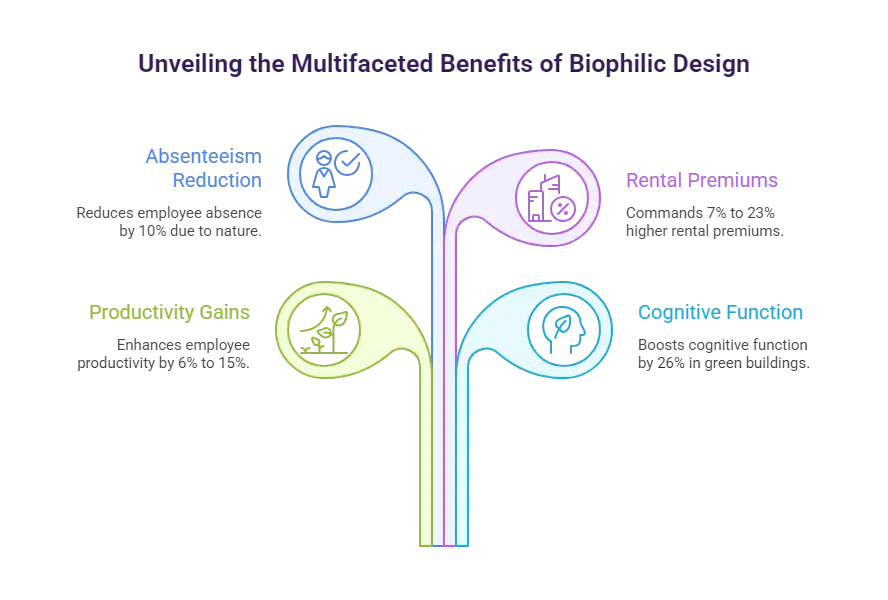
Measurable Outcomes of Biophilic Design:
- Productivity Gains: Research indicates a 6% to 15% increase in productivity for staff in biophilic environments.
- Cognitive Function: A Harvard T.H. Chan School of Public Health study found a 26% boost in cognitive function scores in green-certified buildings.
- Absenteeism Reduction: 10% of employee absence can be attributed to architecture lacking nature, costing the global economy billions.
- Rental Premiums: Commercial spaces with significant biophilic elements command a 7% to 23% rental premium compared to standard buildings.
Action Steps: How to Deploy This Today
You do not need to rebuild your portfolio from scratch to see results. Here are three immediate actions to capture biophilic design ROI productivity:
- Conduct a “Green Audit”: Don’t just buy plants. Measure the visual connection to nature from every desk. If a tenant cannot see a natural element (plant, wood, water, or sky) from their chair, that square footage is underperforming.
- Upgrade to Circadian Lighting: Replace static 5000K LEDs with tunable systems that mimic the solar path. This regulates tenant sleep-wake cycles, ensuring they are alert during high-value work hours.
- Monitor Environmental Data: Install sensors to track CO2, VOCs, and humidity in real-time. Use this data to prove to prospective tenants that your building is a performance-enhancing machine.
Questions you might have
Overcoming Skepticism in Biophilic Design
Q1Is biophilic design just about adding potted plants?No. It is structural, not decorative.+
While plants are a component, true biophilic design ROI productivity relies on complex systems: air quality, circadian lighting, natural materials, and fractal patterns.
Q2Isn't this too expensive for commercial development?This is a misconception.+
The upfront cost is marginal compared to the long-term operational gains. When you factor in higher retention rates and rental premiums, the ROI is usually positive within the first lease cycle.
Q3How do I prove this to my investors?Use the Terrapin Bright Green reports as your baseline.+
Show them the "3-30-300" rule. Demonstrate that you are optimizing the tenant's highest cost (people), which justifies a higher rent for your building
Stop Thinking, Start Knowing
Architecture has relied on “I think” for too long. It is time to transition to “I know.”
The data is clear. Buildings that ignore human biology are depreciating assets. Buildings that embrace evidence-based design are profit generators. By focusing on biophilic design ROI productivity, you move beyond selling space and start selling success.
Do not let your next project be just another building. Make it a high-performance asset. Let the data drive your design, and the profit will follow.
Ready to Charge What You’re Worth?