
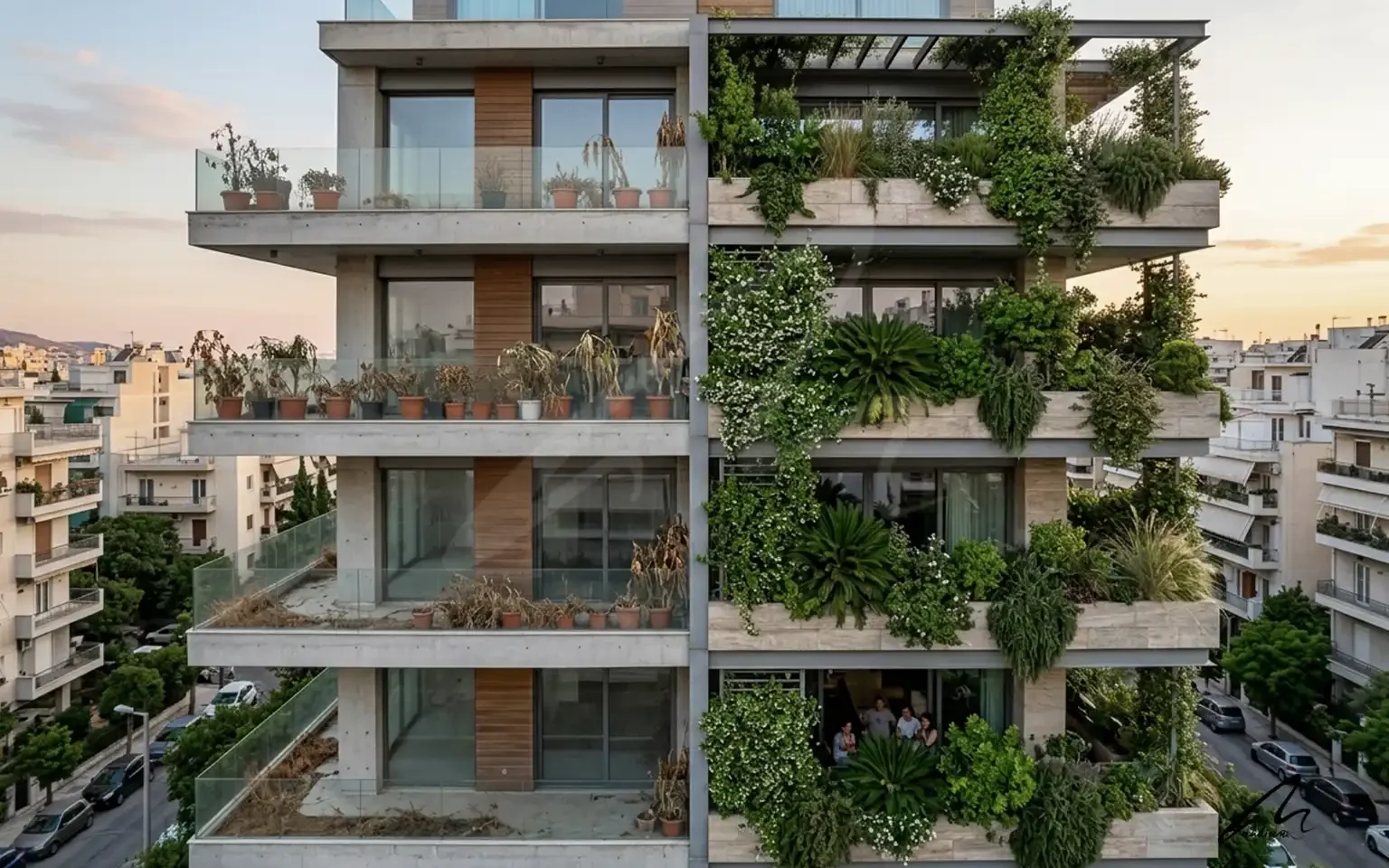
You are likely losing money on your landscaping budget. It happens during the late stages of design when a developer looks at a 3D visualization and decides the project needs more ‘greenery’ to justify the price point. Consequently, the architect adds potted trees, some ivy on a trellis, and perhaps a roof garden. This is a mistake. It is an expensive aesthetic patch for a structural performance deficit. You are buying green jewelry, and like jewelry, it depreciates while requiring constant polishing.
In the economics of space, greenery must be treated as infrastructure. When you treat it as an ornament, you incur high CAPEX with zero functional return. Therefore, the plants die, the irrigation leaks, and the maintenance fees climb. This is not a sustainability strategy; it is a budget leak. Real performance comes from understanding how biological systems interact with the physics of your building.
TL;DR The Executive Summary +
- Problem: Real estate developers treat greenery as a decorative marketing expense rather than a functional performance asset.
- Evidence: Research indicates that 40% of urban greening projects fail within five years due to poor species selection and lack of structural integration.
- Method: We apply spatial analysis and microclimate modeling to replace aesthetic landscaping with high-performance ecosystem services.
- Result: Integrated biological systems reduce building cooling loads by up to 15% and significantly increase long-term asset valuation.
The Failure of Ornamental Greenery
Most developers view greenery through the lens of ‘curb appeal.’ They believe that more plants lead to faster sales. While this is true in the short term, it creates a long-term liability. Bockarjova et al. (2020) [Journal of Environmental Science & Policy] found that while proximity to high-quality green space increases property values by up to 20%, the ‘quality’ is defined by ecological function, not just visual density. If the greenery does not provide shade, reduce wind, or manage stormwater, it is a net drain on the asset.
You are likely making the developers green mistake ROI by choosing species that cannot survive the microclimate of your specific balcony or roof. A plant that thrives in a park will die on the 15th floor of a glass tower. The result is a cycle of replacement that erodes your operating margin.
Shifting from Aesthetics to Performance
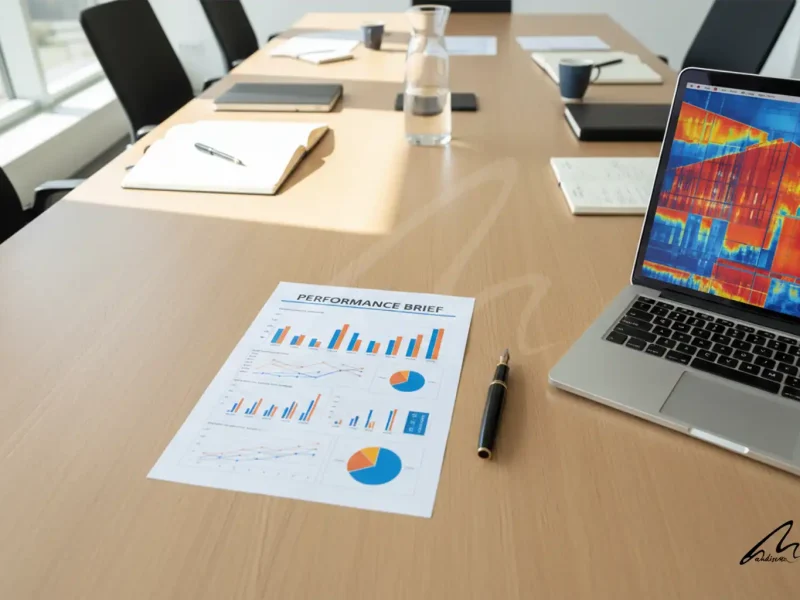
To fix this, you must change your procurement process. You do not need a landscaper; you need an urban performance strategy. This means moving the green conversation from the end of the project to the performance brief architecture stage.
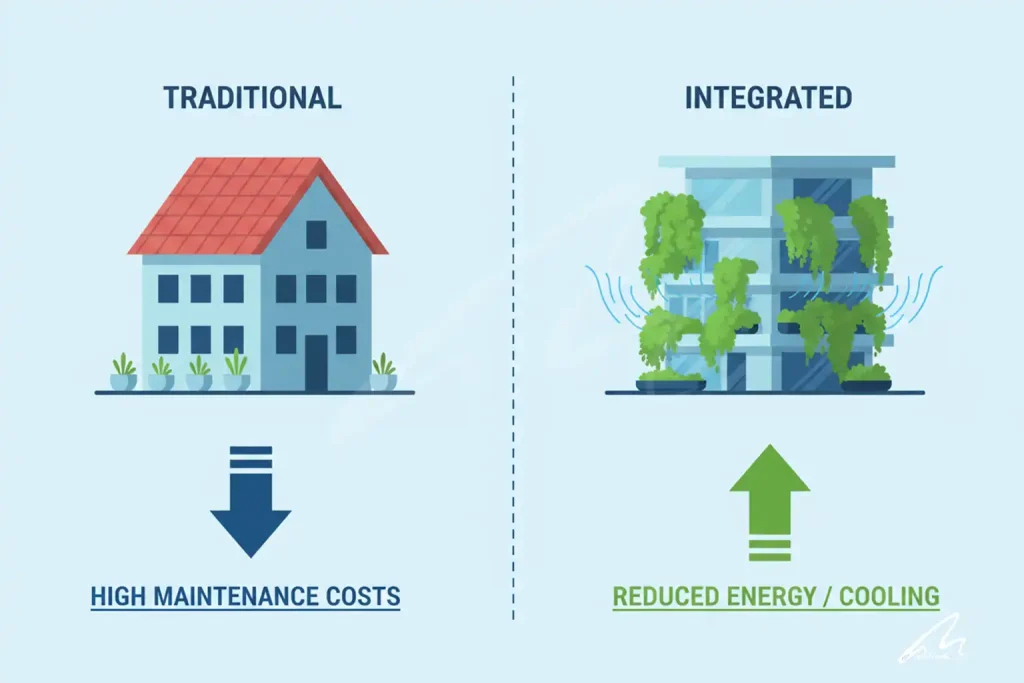
Instead of asking ‘Where can we put plants?’, you should ask ‘How much can biological cooling reduce our HVAC requirements?’. This shift in perspective transforms a cost center into a yield generator. For example, a properly integrated green facade can reduce surface temperatures by up to 12 degrees Celsius. Consequently, your chillers work less, your energy bills drop, and your Net Operating Income (NOI) increases. This is the only green real estate ROI that matters to an institutional investor.
The Economics of Ecosystem Services
We categorize these benefits as ‘Ecosystem Services.’ This is not a soft term. It is a financial metric. When a tree provides shade to a building, it is performing a service that would otherwise require electricity and mechanical equipment. Therefore, the tree has a replacement value. If your design ignores this, you are effectively leaving free energy on the sidewalk.
Furthermore, the psychological impact of functional green space is measurable. Studies have linked high-quality biological integration to lower tenant turnover and higher lease premiums. People do not just want to look at a tree; they want to live in a microclimate that feels comfortable. Consequently, the ‘green’ in your project should be measured by its ability to mitigate the urban heat island effect, not its color in a rendering.
Stop Buying Plants, Start Building Systems
If you want to avoid the most common expensive mistake in modern development, you must stop buying plants by the dozen. Start investing in biological systems. This requires a deep analysis of site-specific data: solar radiation, wind patterns, and local ecology. Only then can you select the biological interventions that will actually protect your asset’s value over a thirty-year horizon.
Your buildings fail when they are treated as static objects. They are part of a dynamic urban environment. If your ‘green’ strategy does not account for this, it will fail both ecologically and financially. You can find more data on how this affects your bottom line in our performance reports.
Design for the balance sheet. The aesthetics will follow naturally. The result is a more resilient building, a more satisfied tenant, and a significantly higher ROI.
You Might Be Wondering
Honest answers to real objections
Q1Isn't any green space better than a concrete wall for sales?No, failing greenery is a financial liability that hurts long-term brand equity and asset value.+
Q2How do you calculate the actual ROI of a tree?We use energy modeling and market data to quantify the exact energy savings and lease premiums generated by specific biological assets.+
Q3Biological systems sound more expensive than standard landscaping. Why do it?The higher performance offsets the initial cost within 3-5 years through reduced OPEX and increased asset resilience.+
Ready to Charge What You’re Worth?