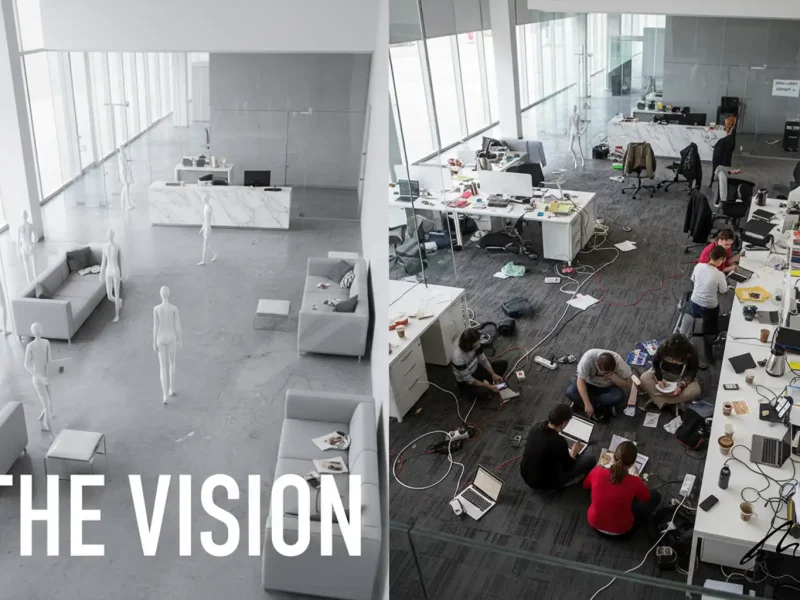


You are likely wasting money on your current project. You are wasting it because you have started the design process with a list of rooms rather than a set of performance targets. Most architectural briefs are wishlists. They describe a ‘vision’ or a ‘vibe’ and list the number of toilets required. Consequently, the architect designs for the vibe, and you pay for the toilets. But no one has defined how the building should actually perform. This is why you need a performance brief architecture strategy. It is the only way to ensure your asset delivers the value you expect.
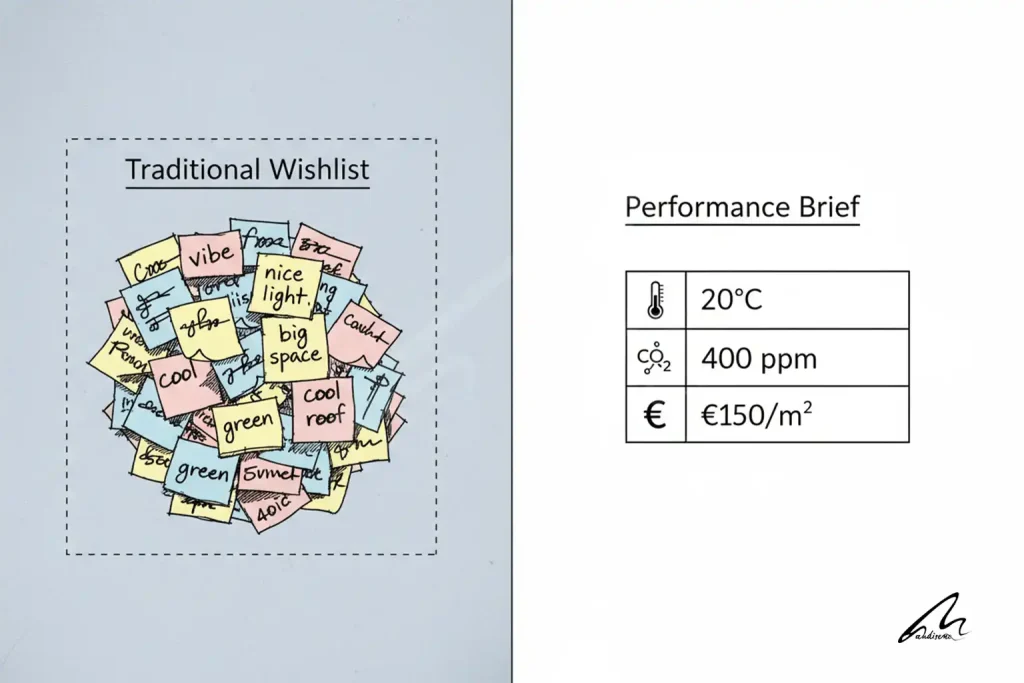
Traditional briefing fails because it focuses on inputs. You ask for 5,000 square meters of office space. You get 5,000 square meters of office space. However, if that space is too hot to work in by 2 PM or if the layout discourages the very collaboration you promised your tenants, the input is irrelevant. The building has failed. A performance brief flips this logic. It focuses on outputs. Instead of asking for a lobby, you ask for a specific rate of footfall or a documented level of thermal comfort. You set the scoreboard before the game begins.
TL;DR The Executive Summary +
- The functional brief is obsolete because it lists rooms without defining how those rooms must perform for the bottom line.
- Research shows a significant performance gap between design intent and actual building operation, often due to vague briefing.
- A performance brief uses measurable targets—thermal, social, and economic—to guide the design process from day one.
- Front-loading the brief results in higher asset value, lower operational costs, and reduced risk for investors.
The Economic Failure of the Functional Brief
In a typical client conversation, the fee is the first hurdle. You might think that spending time on a performance brief architecture phase is an unnecessary expense. This is a mistake. When you skip the performance definition, you move the most expensive decisions into the construction phase. Therefore, the result is a cycle of value engineering that strips the quality out of the project without actually improving its performance. You end up with a building that meets the code but fails the market. This is where many architect fee proposals fail to capture the true value of the consulting phase.
Consider the ‘Performance Gap’. This is the documented difference between how a building is predicted to perform and how it actually functions once occupied. In a seminal study, researchers found that actual energy use can be 2.5 times higher than the design prediction Bordass & Leaman, 2005 — Building Research & Information. This gap exists because the brief did not mandate performance. It only mandated design. When you define performance in the brief, you create a legal and technical baseline that the design team must meet. This shifts the risk from the owner to the design solution.
Defining the Metrics of Success
What does a performance brief actually look like? It is a document composed of numbers, not adjectives. If you find yourself using words like ‘innovative’ or ‘flexible’, delete them. These words are unmeasurable. They provide no guidance. Instead, you must specify the exact metrics that define success for your specific asset. This might include a maximum kWh/m2/year for energy, a minimum daylight factor for 90% of occupied desks, or a specific acoustic threshold that supports deep work.
This level of detail requires an evidence-based approach. You cannot guess these numbers. You must derive them from peer-reviewed research and local economic data. For example, if you are developing a commercial building, you should look at the correlation between air quality and cognitive function. This allows you to set a performance target for CO2 levels that directly supports the productivity of your tenants. This isn’t just ‘green’ design; it is asset optimization. You are building a product that is demonstrably better than the competition. You can read more about how this impacts the ROI for developers who often prioritize the wrong metrics.
The Post-Occupancy Feedback Loop
A performance brief architecture strategy is incomplete without a plan for measurement. You cannot manage what you do not measure. Consequently, the brief must include a requirement for post-occupancy evaluation (POE). This is the final step in the performance cycle. It involves measuring the building after it has been occupied for twelve months to see if it hit the targets set in the initial brief.
This creates accountability. If the design team knows the building will be tested, the quality of the design increases. They focus on the details that matter—the junctions, the shading, the air tightness—rather than just the visual render. Furthermore, POE provides you with the data you need to market the building. You are no longer selling ‘good design.’ You are selling ‘proven performance.’ You can see how this data is integrated into post-occupancy evaluation projects to refine future briefing. This data is your most valuable intellectual property. It tells you what to build next.
Implementation: How to Start
Start by identifying your non-negotiables. These are the economic and environmental targets that your project must hit to be considered a success. Then, hire a performance consultant before you hire a design architect. The consultant’s job is to write the brief that the architect will follow. This ensures that the design is a response to a rigorous set of requirements rather than a self-referential aesthetic exercise.
A performance brief is your insurance policy. It ensures that every Euro spent on design and construction is working toward a specific, measurable outcome. It eliminates the ‘vibe’ and replaces it with value. This is not just a different way of working. It is the only logical way to build in a high-risk, low-margin environment. The result is a building that performs for the planet, for the people inside it, and for your bank account. Stop drawing. Start measuring.
You Might Be Wondering
Honest answers to real objections
Q1Does a performance brief delay the project schedule?A performance brief prevents delays by resolving performance conflicts before the drawing starts.+
Q2Is this approach only for large-scale institutional projects?Every building has a performance profile that can be optimized regardless of size.+
Q3Doesn't this limit the architect's creativity?A performance brief directs creativity toward solving real problems rather than just making images.+
Ready to Charge What You’re Worth?