

You are sitting across from a developer who just told you that your fee is 0.5% higher than your competitor. You explain your design philosophy. You talk about your firm’s history. You describe the beauty of the facade. The developer nods, but they are looking at a spreadsheet. To them, you are a commodity. You are a cost to be managed, not an asset to be utilized. This happens because most architects fail to communicate the economics of space.
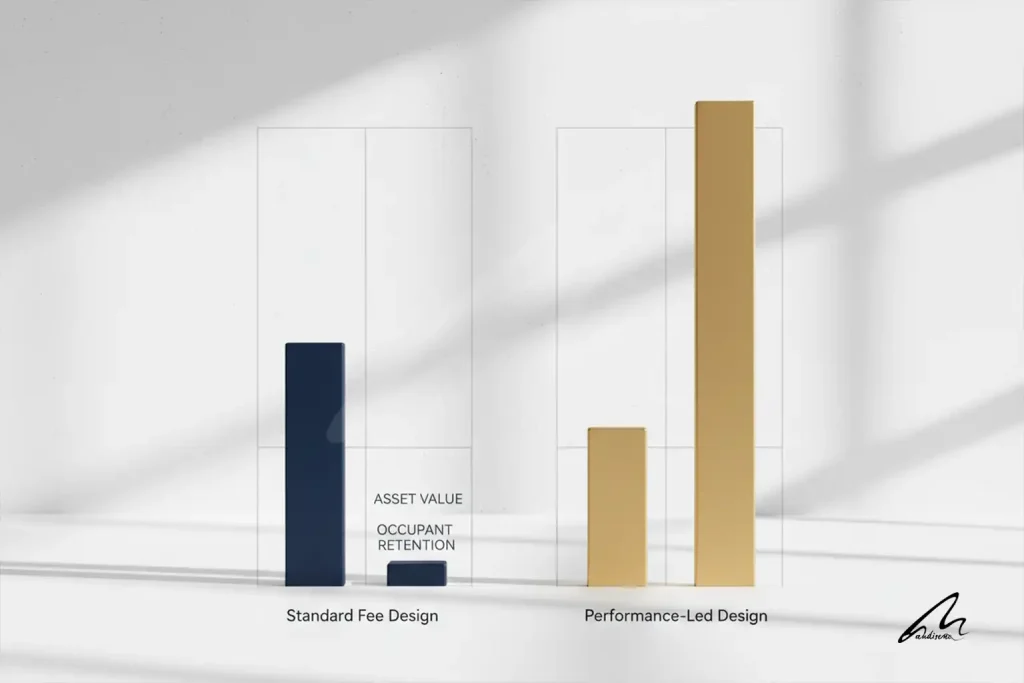
Standard percentage-based fees are a race to the bottom. When you charge based on the cost of construction, you have a perverse incentive to make things more expensive or, worse, you find yourself squeezed by clients who view your work as a legal requirement rather than a value driver. To break this cycle, you must change the language of your pitch. You must move from ‘design services’ to ‘performance delivery’.
Consequently, you need to include specific architecture fee proposal metrics that translate spatial quality into the only language investors truly prioritize: financial performance. Here are the five metrics you must include to change the conversation.
TL;DR The Executive Summary +
- Architects consistently lose bids because they compete on percentage-based fees rather than measurable project outcomes.
- Evidence-based data shows that thermal comfort, spatial efficiency, and green proximity directly impact a building's financial yield.
- Transition your proposal from a list of tasks to a series of performance benchmarks backed by peer-reviewed research.
- The result is a fee structure based on value creation, making your services an investment rather than a line-item expense.
1. Spatial Efficiency vs. Operational Yield
Most proposals discuss Net Internal Area (NIA) as a static number. This is a mistake. You should instead propose a metric for Spatial Performance Density. This measures how much of the building actually generates revenue versus how much is ‘dead’ space like over-engineered circulation or poorly lit corners.
If you can demonstrate that your design increases the usable high-value floor area by even 3% through smarter core placement, you have already paid for your fee ten times over. Therefore, do not just list ‘Floor Plans’ in your scope. List ‘Net-to-Gross Optimization for Maximum Yield’. This shifts the focus from the drawing to the result. It transforms a drafting task into a financial optimization exercise.
You can read more on how this logic applies to building longevity in our analysis on Why Buildings Fail People Before They Fail Structurally.
2. Thermal Comfort and Productivity Loss
Designers often treat HVAC and insulation as technical requirements. To an investor, these are insurance policies against tenant turnover. Research indicates that human performance drops by roughly 1% for every degree Celsius the temperature rises above 23°C Seppänen et al., 2006 – Indoor Air Journal.
In your proposal, include a metric for Predicted Occupant Productivity. Explain how your building’s envelope design will maintain a specific thermal range that minimizes cognitive decline. If a commercial tenant knows their employees will be 2% more productive in your building, they will pay a higher rent. This means your fee is no longer an expense. It is a yield-enhancement strategy.
3. Biophilic Proximity and Asset Appreciation
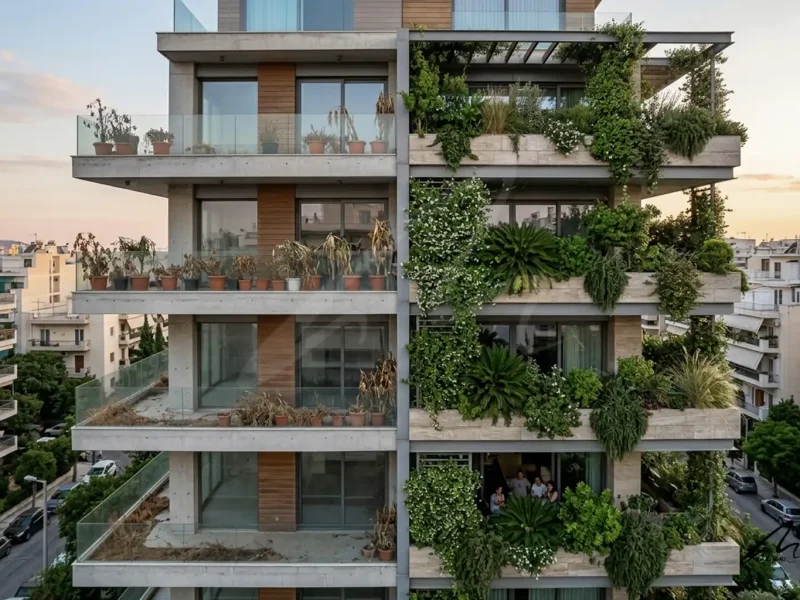
Stop selling ‘landscaping’. Sell ‘Natural Capital Appreciation’. Data consistently shows that office workers with views of greenery are more productive and take fewer sick days. More importantly for the developer, properties with high-quality biophilic integration command a rental premium of 7% to 12%.
Use a metric called the Biophilic Access Score. Define this as the percentage of workstations within 10 meters of a high-quality green view. Consequently, the client sees your ‘green’ ideas not as an aesthetic flourish, but as a mechanism to increase the asset’s capitalization rate.
For deeper evidence on this, see Biophilic Design Beyond Plants: What 40 Years of Research Actually Says.
4. Walkability as a Financial Instrument
If you are working on an urban site, the walkability of the surrounding precinct is your most powerful economic lever. A one-point increase in a property’s Walk Score correlates with an increase in property value of between $500 and $3,000 per unit, depending on the market Pivo & Fisher, 2011 – Real Estate Economics.
Include a Walkability ROI Projection in your proposal. Show how your ground-floor permeability and site integration will boost the local Walk Score. This proves you are not just designing a building; you are engineering a financial instrument.
This is why we argue that Walkability Is Not a Lifestyle Choice. It’s a Financial Instrument.
5. Post-Occupancy Performance Benchmarking
The traditional fee ends at the handover. This is the biggest missed opportunity in the profession. In your fee proposal, include a mandatory line item for Post-Occupancy Evaluation (POE) twelve months after completion.
Propose a metric for Actual vs. Predicted Performance. This allows you to prove your design worked. Consequently, you build a library of evidence that makes your next fee proposal impossible to reject. You are no longer guessing. You are stating facts. This turns your previous projects into your most effective sales force.
Learn how to leverage this data in How to Turn a Post-Occupancy Evaluation Into Your Next 3 Projects.
Stop Competing on Price
The next time a client asks you to lower your fee, do not negotiate the percentage. Negotiate the metrics. If they want a cheaper architect, they are choosing a lower-performing asset.
Presenting your fee alongside these five metrics proves that you understand the client’s risk. It shows you are committed to the building’s life-cycle performance rather than just its appearance. The result is a professional relationship built on mutual economic interest. You are no longer an architect looking for a job. You are a consultant providing a solution.
Precision matters. Data wins. Put the metrics in the proposal and watch the price conversation disappear.
Try our ROI calculator for your next project for free.
You Might Be Wondering
Honest answers to real objections
Q1Won't developers think these metrics are just a way to justify higher fees?No, if you present the metrics as a risk-mitigation and yield-generation strategy.+
Q2I don't have the data for my specific project yet. How can I include these?Use peer-reviewed industry standards as a baseline for your project's performance targets.+
Q3What if the building fails to meet the metrics I proposed?Frame the metrics as design performance targets that guide the decision-making process.+
Ready to Charge What You’re Worth?