
Copenhagen flooded in 2011. In less than three hours, 150mm of rain fell on the city, resulting in over $1 billion in insurance claims. This was not an anomaly; it was a baseline shift. Consequently, the city realized that digging larger pipes was a losing game. You cannot outrun climate change with concrete alone. The result of this realization was the Copenhagen Climate District in Sankt Kjelds, a neighborhood-scale laboratory for urban performance.
Sankt Kjelds is the world’s first resilient neighborhood. The project transformed 30,000 square meters of urban space, replacing 20% of the asphalt with vegetation. The district now manages a 100-year cloudburst event using nature-based solutions rather than hidden sewers. This transition from ‘grey’ to ‘blue-green’ infrastructure is not about aesthetics. It is about financial risk mitigation. When you reduce the peak load on the city’s drainage system, you prevent the structural and economic collapse of the surrounding real estate.
Traditional engineering views water as a waste product. You see a drain; they see a cost. This perspective is flawed. The Copenhagen Climate District treats water as a resource that dictates the shape of the street. It uses ‘cloudburst boulevards’—streets designed with a V-shaped profile to funnel overflow safely toward the harbor. This prevents water from entering basements and destroying electrical systems. Therefore, the street performs two functions: mobility during the dry season and drainage during the wet season. You can learn more about the performance of Sankt Kjelds here.
TL;DR The Executive Summary +
- Traditional sewage systems cannot handle the increasing frequency of extreme 'cloudburst' events.
- The 2011 Copenhagen flood caused over $1 billion in damages in just two hours, proving infrastructure failure.
- The Sankt Kjelds Climate District replaces expensive underground pipes with surface-level landscape performance.
- This shift reduces flood risk while simultaneously increasing local property values and social cohesion.
The shift from drainage to performance
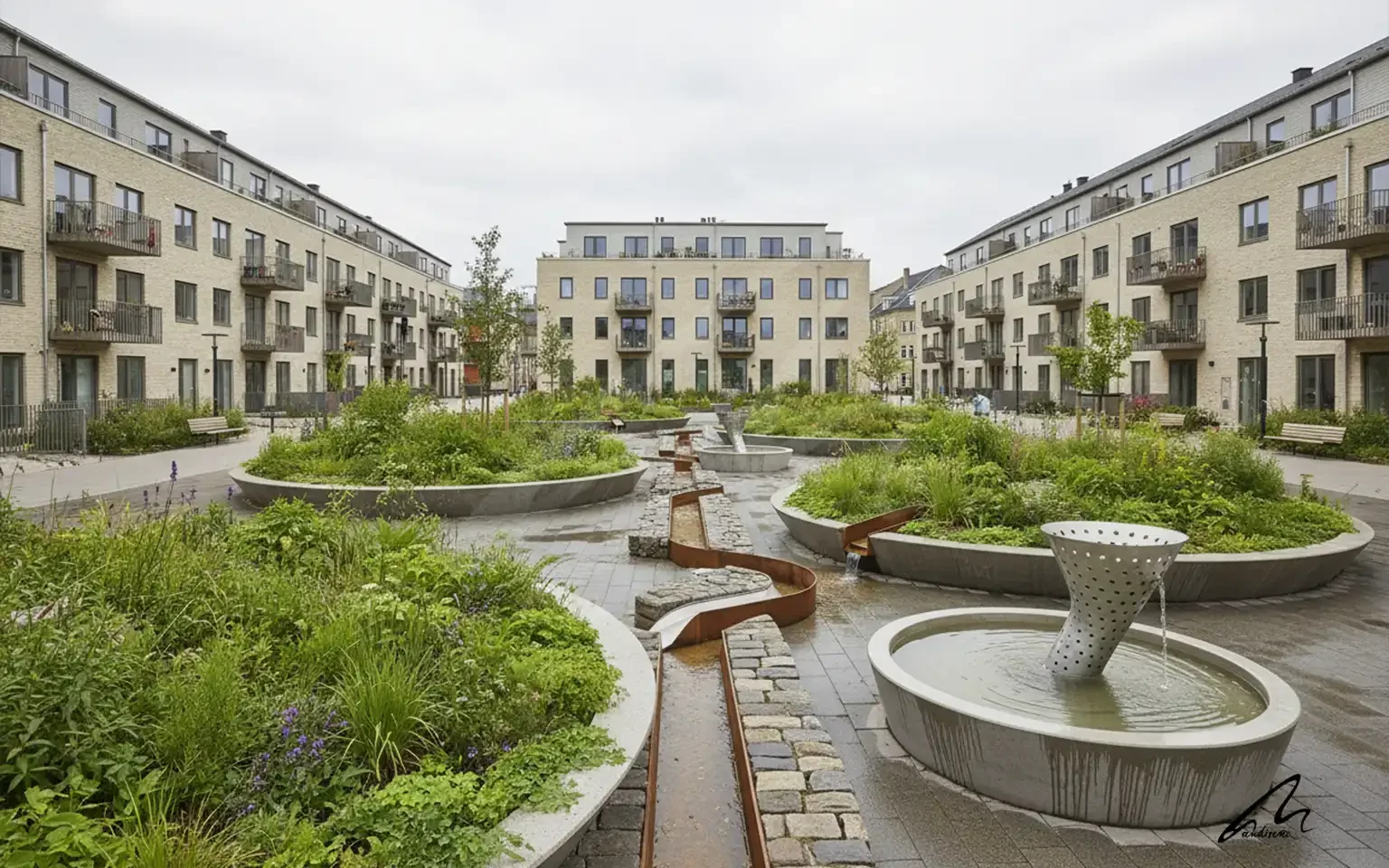
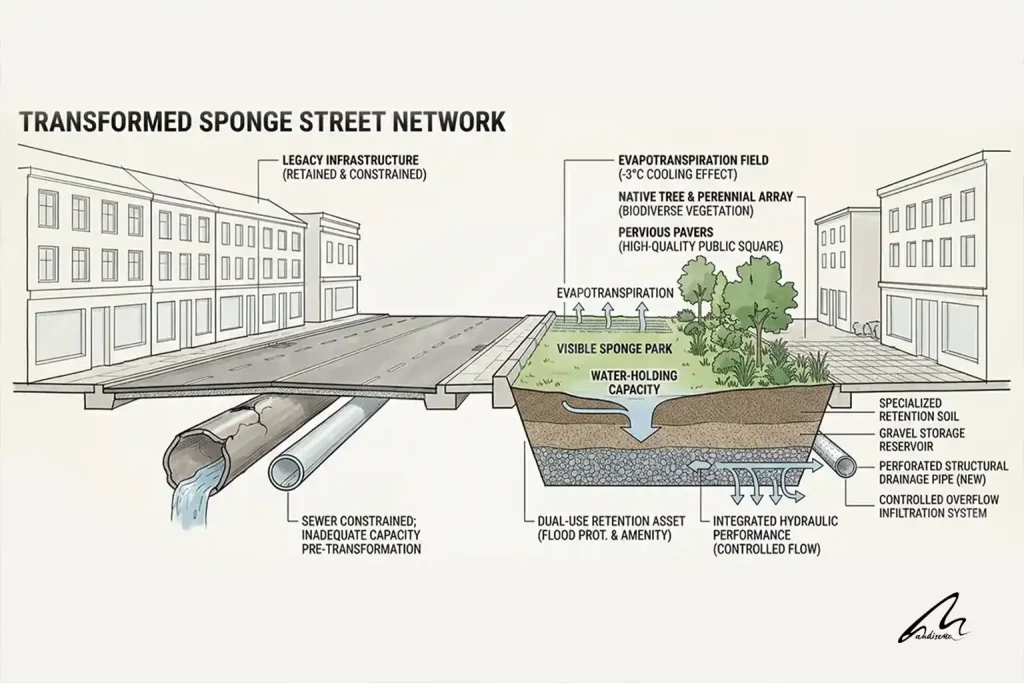
Most cities treat rainwater as a waste product to be removed as quickly as possible. This approach is a strategic error. In the Copenhagen Climate District, urban planners treated water as a design driver rather than a nuisance. They transformed 50,000 square meters of asphalt into green urban spaces designed to act as sponges. This was not an aesthetic choice. It was a hydraulic calculation. By lowering the center of parks like Tåsinge Plads, the city created temporary reservoirs that hold millions of liters of water during a storm. This prevents the sewage system from surcharging. Therefore, the city avoids the catastrophic backflow that floods basements and destroys commercial inventory.
This method demonstrates that infrastructure can be an amenity. When it is not raining, these hydraulic basins serve as high-quality public squares. You are looking at a dual-use asset. The city pays for flood protection but receives a park for free. This is the fundamental lesson for any planner: performance must be integrated, not isolated.
Water 2017, — Copenhagen’s First Climate Resilient Neighbourhood
The economics of surface-level resilience
Traditional gray infrastructure—concrete pipes and pumps—depreciates the moment you bury it. It offers zero secondary value to the citizens. In contrast, the green-blue infrastructure of the Copenhagen Climate District actively appreciates. Research shows that proximity to high-quality green space directly correlates with a rise in real estate premiums. By choosing surface-level solutions, the municipality did more than fix a drainage problem; they stimulated the local economy.
This means the ROI of a climate-adapted street is higher than a standard road reconstruction. You are not just spending capital; you are protecting the tax base. When a neighborhood is shielded from flood risk, insurance premiums stabilize and investment returns. Consequently, developers are more likely to commit to long-term projects. This is why walkability is not a lifestyle choice. It’s a financial instrument.
Why topography is your best engineer
The planners in Sankt Kjelds utilized the existing topography of the city to direct water flow. They designed ‘Cloudburst Streets’ with high curbs on one side and V-shaped profiles. These streets act as canals during extreme events, guiding water toward the harbor and away from vulnerable buildings. This is passive engineering. It requires no electricity and minimal maintenance compared to mechanical pumping stations.
If you are a planner, your first move should be a digital elevation model. Understand where the water wants to go. Then, design the street to facilitate that movement rather than fighting it. The result is a city that fails gracefully rather than catastrophically.
Quantifying the biological cooling effect
The Copenhagen Climate District also addresses the urban heat island effect. While the primary goal was water management, the addition of thousands of new trees and perennials lowered local ambient temperatures. During heatwaves, these green pockets are up to 3 degrees Celsius cooler than the surrounding paved streets. This reduces the cooling load on adjacent buildings.
This is a secondary economic benefit that many planners ignore. Reduced energy consumption leads to lower operating costs for tenants. Furthermore, the psychological benefit of urban nature reduces stress and improves public health outcomes. You are building a system that protects both the physical structure and the human performance of the city. You can find more on this in our analysis of the 3.6°C problem and what urban trees actually do.
Lessons for global implementation
You do not need Copenhagen’s budget to apply these principles. The core strategy is the reallocation of space. Most cities dedicate 30% to 50% of their land area to cars. By reclaiming just 10% of that asphalt for hydraulic retention, you can solve most mid-level flooding issues. Start with the intersections. These are often over-engineered and under-utilized. Transform them into ‘rain gardens’ that filter water before it enters the ground.
Stop viewing climate adaptation as a cost center. It is an opportunity to fix the broken urbanism of the 20th century. The Copenhagen Climate District proves that a resilient city is a more profitable, more livable, and more beautiful city. The data is clear. The results are measurable. Therefore, any planning department still relying solely on underground pipes is effectively planning for failure.
You Might Be Wondering
Honest answers to real objections
Q1Isn't surface-level water management more expensive to maintain than underground pipes?No, it is a more cost-effective strategy because it provides multiple urban benefits for a single investment.+
Q2Does this approach work in high-density cities with limited space?Yes, density makes these interventions more necessary because the cost of flood damage per square meter is much higher.+
Q3Will these 'rain gardens' become breeding grounds for mosquitoes or pests?No, properly engineered climate districts ensure water is filtered and drained before it can attract pests.+
You Might Be Wondering
Overcoming Skepticism
Q1Isn't surface-level water management more expensive to maintain than underground pipes?No, it is a more cost-effective strategy because it provides multiple urban benefits for a single investment.+
While green infrastructure requires landscaping and debris removal, it avoids the massive capital costs of pipe replacement and emergency flood repairs. The long-term lifecycle cost is significantly lower when you factor in the avoided damage to private property.
Q2Does this approach work in high-density cities with limited space?Yes, density makes these interventions more necessary because the cost of flood damage per square meter is much higher.+
Copenhagen is a dense European capital, and the Sankt Kjelds district is a prime example of high-density integration. It requires reclaiming space from underutilized roadways and parking, which actually improves the quality of the public realm.
Q3Will these 'rain gardens' become breeding grounds for mosquitoes or pests?No, properly engineered climate districts ensure water is filtered and drained before it can attract pests.+
The systems are designed for rapid infiltration and temporary retention, not permanent standing water. Water typically drains within 24 to 48 hours, which is faster than the breeding cycle of most pests.
Ready to Charge What You’re Worth?